CALYPSIONINNOVATIONS
Link360 Suite
LinkEdge™LinkVision™LinkTrack™LinkTwin™LinkSim™IronTrust™
Explore
About UsContact UsBook a Walkthrough
LinkEdge™ LE-100 · Industrial edge gateway

Redefining the industrial edge gateway.

The zero-engineering connectivity standard.

Traditional gateways need weeks of machine-side programming. The LE-100 sweeps its ports, fingerprints the equipment it finds and streams normalised telemetry in hours with Autonomous Protocol Discovery (patent published).

Patent published IN 202541089083 Zero code integration
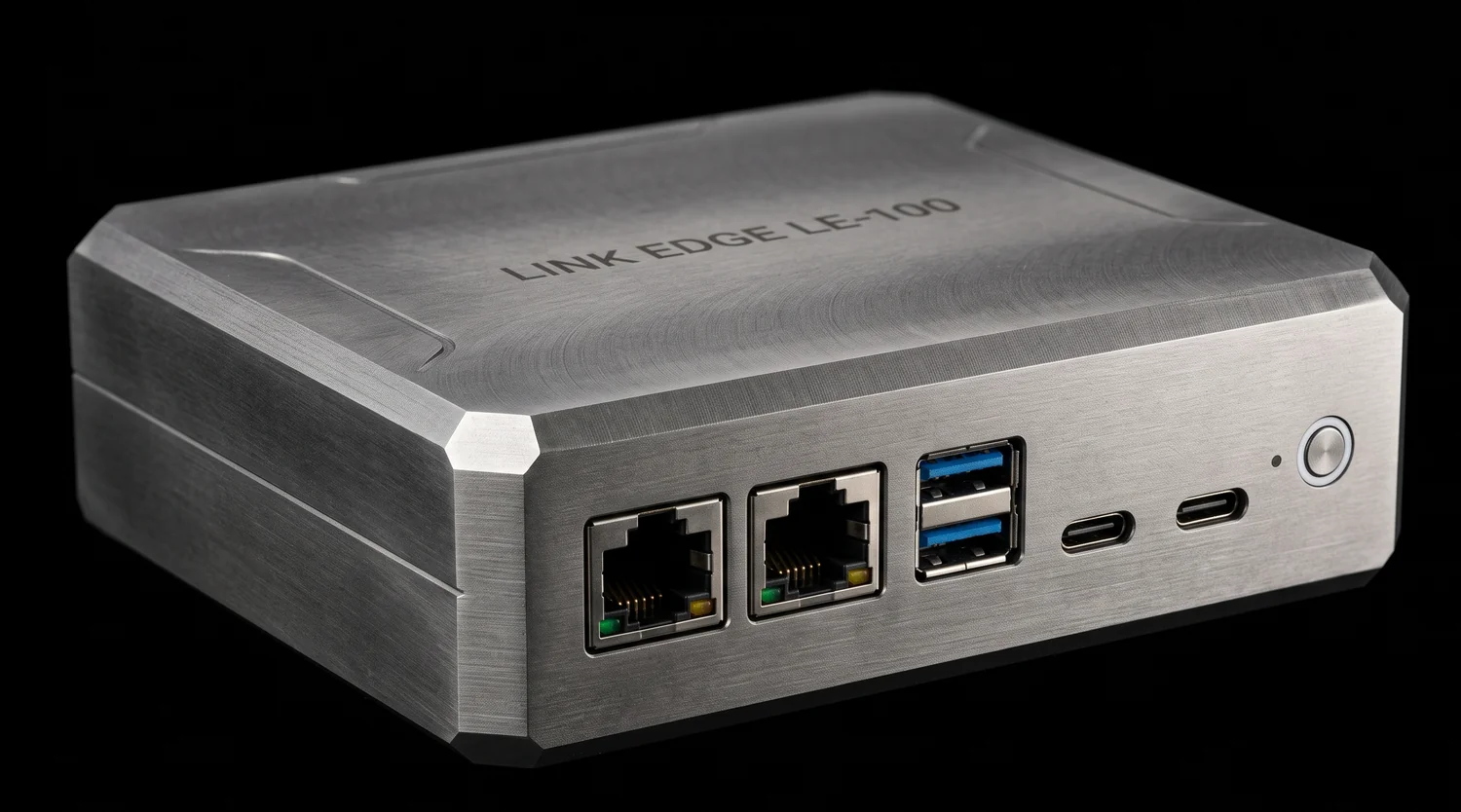
LinkEdge LE-100 industrial edge gateway, front view with two Ethernet ports
12,400Tag reads per second, sustained
2,400+Tags at 200 ms scan, zero missed deadlines
<0.1 msProtocol conversion per tag
Store & forwardBuffers data through uplink outages
Universal OT & IT connectivity
Up to124industrial protocols
supported

From Modbus to OPC UA to MTConnect, the LE-100 supports up to 124 industrial protocols, with Autonomous Protocol Discovery mapping them on connection. Contact us to confirm support for a specific protocol.

Industrial Ethernet
  • Modbus TCP
  • OPC UA
  • EtherNet/IP
  • PROFINET
PLC native
  • S7comm
  • MELSEC MC
  • FINS
  • ADS
Serial
  • Modbus RTU
  • Modbus ASCII
  • RS-485
  • RS-232
Fieldbus & vehicle
  • CANopen
  • SAE J1939
Machine tool
  • MTConnect
  • Open Protocol
Building & network
  • BACnet/IP
  • KNX/IP
  • SNMP v1/v2c/v3
Utility & SCADA
  • DNP3
  • IEC 60870-5-104
  • M-Bus
IoT & data
  • MQTT
  • HTTP/REST
  • WebSocket
  • BLE GATT
  • SQL
  • I²C
How it's different

The 3 Architectural Shifts

From passive translation box to autonomous discovery, plug-and-play ingestion, and multi-format fan-out.

Configuration

Manual Gateway Setup Autonomous Discovery

Conventional Edge

Weeks of manual port setup, register-by-register offset coding, and baud-rate mapping, per machine.

LinkEdge LE-100

Provide a network IP and credentials: our patent-published engine sweeps ports, fingerprints hardware, and maps tags in hours.

PatentIndian patent published · 202541089083
Integration

Manual Driver Coding Plug-and-Play Ingestion

Conventional Edge

Custom vendor drivers (MTConnect, S7, FINS) and per-machine parsing code for every connection.

LinkEdge LE-100

True plug-and-play: auto-detects the protocol, connects, and fetches live tags with no machine-side code.

ConnectorsUp to 124 Protocols
Data Output

Rigid Single Schema Multi-Format Fan-Out

Conventional Edge

A single fixed payload structure, locked to one proprietary cloud or broker.

LinkEdge LE-100

Universal transformation & fan-out to custom types (JSON, XML, Protobuf), streamed to REST/HTTPS, MQTT, ERP, MES and SQL at once. The same data feeds discrete event simulation in LinkSim™.

Fan-outJSON · XML · Protobuf
Built into the hardware

Core Reliability & Security

Standard on every LE-100: no add-ons, no configuration.

Reliability

Thread-Isolated Scan Loops

Every connected device runs on an independent scan loop, so a slow or failed PLC never freezes adjacent plant streams.

100% scan-deadline adherence · 12,400 tag-reads/s
Buffering

32 GB Store-and-Forward

Onboard industrial eMMC buffers telemetry during WAN drops and back-fills on reconnect, expandable via memory-card storage for deeper buffers.

>60,000 msg/s back-fill · 32 GB eMMC + memory-card expandable
Security

Hardware-Grade Security

Dedicated hardware secure element, encrypted credential vault, and physical GbE plant-LAN vs. WAN port isolation.

Secure element · LAN / WAN isolation
Head to head

Hardware & Performance Comparison Matrix

Side-by-side evaluation comparing conventional industrial gateways against the Calypsion LinkEdge LE-100 Series.

Category
Conventional Edge Gateways
LinkEdge LE-100
Protocol Discovery
Conventional EdgeManual register-by-register tag mapping taking weeks per machine.
LinkEdge LE-100Autonomous Protocol Detection (Patent 202541089083) self-configures in hours.
Protocol Coverage
Conventional EdgeLimited baseline drivers; extra protocols require paid software licenses.
LinkEdge LE-100Supports up to 124 industrial protocols (Modbus, OPC UA, S7, FINS, MTConnect, etc.). Specific protocols confirmed on request.
Scan Loop Architecture
Conventional EdgeShared scan loops; a single unresponsive PLC halts the entire polling cycle.
LinkEdge LE-100Independent scan loop per device; an offline unit never stalls adjacent streams.
Sustained Throughput
Conventional EdgeDropped frames and high latency under heavy multi-tag sampling.
LinkEdge LE-10012,400 tag-reads/s sustained across 2,400+ active tags.
Timing Guarantees
Conventional EdgeHigh scan jitter and missed polling deadlines under load.
LinkEdge LE-100100% scan deadline adherence with <15 ms scan jitter at full load.
Outage Buffering
Conventional EdgeUnbuffered pass-through; telemetry is lost immediately on link drop.
LinkEdge LE-10032 GB industrial eMMC store-and-forward buffer with >60,000 msg/s drain rate.
Network & Cyber Security
Conventional EdgeShared interfaces and plain-text configuration files.
LinkEdge LE-100Hardware Secure Element, encrypted keys, and dual isolated GbE plant-LAN/WAN ports.
I/O Interfaces & Isolation
Conventional EdgeUnisolated serial channels vulnerable to ground loops.
LinkEdge LE-1004 × RS-485 (5 kV isolation), 1 × RS-232, 1 × CAN-FD, 4 DI / 4 DO relays.
Computing & MTBF
Conventional EdgeEntry-level microcontroller; restricted memory.
LinkEdge LE-100Quad-core ARM Cortex-A72 (1.5 GHz), 4 GB LPDDR4, 850,000 hrs MTBF.
Automotive & Precision Components Machining

Deployment Record: Automotive Tier-1 Component Supplier

The Challenge

Machining lines suffered from undetected micro-stoppages, station cycle-time imbalances, and unpredicted spindle breakdowns during peak shifts.

The Solution

Connected machine PLCs directly to LinkEdge gateways to stream continuous live OEE telemetry and vibration FFT spectrum data.

14 days
early warning before spindle breakdown
+22%
line-balancing efficiency gain

Flagged critical spindle vibration anomalies 14 days prior to a catastrophic breakdown, saving thousands in unplanned maintenance and increasing line-balancing efficiency by 22%.

Specify & order

Ordering Models & Specifications

Four hardware configurations across cellular and extended-temperature options: one common software platform.

LinkEdge LE-100 Technical Datasheet

Port maps, performance envelope and mechanical drawings (PDF).

Download PDF
LE-100

Base Gateway: 2× GbE, 4× RS-485, RS-232, CAN-FD, 4DI/4DO, Wi-Fi.

0 to 60 °C
LE-100-L

Base Gateway + Integrated 4G LTE Cat-4 Cellular Uplink.

0 to 60 °C
LE-100-X

Extended Temperature Hardware Configuration.

-25 to 75 °C
LE-100-LX

Full Option: 4G LTE Cellular + Extended Operating Range.

-25 to 75 °C
Common plant questions

Straight answers to everyday plant problems.

Practical guidance from our engineers, and where LinkEdge™ fits in.

Ask an engineer

How do you connect old machines to IIoT without replacing their controllers?

Most machines with a PLC or CNC controller can already share data (over Modbus, a serial port or the controller maker's own protocol), so the controller rarely needs replacing. Read the data from the controller without changing its program. For machines with no controller at all, add simple sensors such as current clamps or a run/stop signal. Start with a few signals per machine and expand later.

Where LinkEdge™ fitsThe LE-100 reads up to 124 industrial protocols and connects without any machine-side code. Contact us to confirm support for a specific protocol.

What machine data should we collect first?

Start with the signals that explain lost output: machine state (running, idle, stopped), part count, cycle time and alarm codes. These alone give you OEE and a downtime breakdown. Add energy, temperature and vibration later for the critical machines where failures cost the most.

Modbus or OPC UA: which should we use?

Usually both. Modbus is simple and found on almost every older device, but it only moves numbered registers with no built-in meaning or security. OPC UA is newer, secure and self-describing, and is common on modern equipment. Most plants have a mix, so choose a gateway that reads both and converts everything into one format.

Where LinkEdge™ fitsThe LE-100 handles Modbus, OPC UA and many more side by side.

Is it safe to connect our PLC network to the internet for remote monitoring?

Never expose a PLC directly to the internet. Keep the control network separate from the office network and the internet, and send data out through one device that sits between them, uses encrypted outbound connections and accepts no inbound access to the controllers. Agree one set of rules with IT; IEC 62443 is the usual reference.

Where LinkEdge™ fitsThe LE-100 keeps the plant network and the internet on physically separate ports, with a hardware secure element and an encrypted credential vault.

Will reading data from our PLCs slow down the machine or upset control?

It can, if it is done badly: many PCs each polling the same PLC, reading faster than the PLC's scan time, or requesting tags one at a time. Use one device as the single reader, read in blocks, and poll only as fast as the value really changes. Most counters and machine states need about one read per second, not ten.

Where LinkEdge™ fitsThe LE-100 reads each controller on its own scheduled scan loop, so one slow PLC never holds up the others.